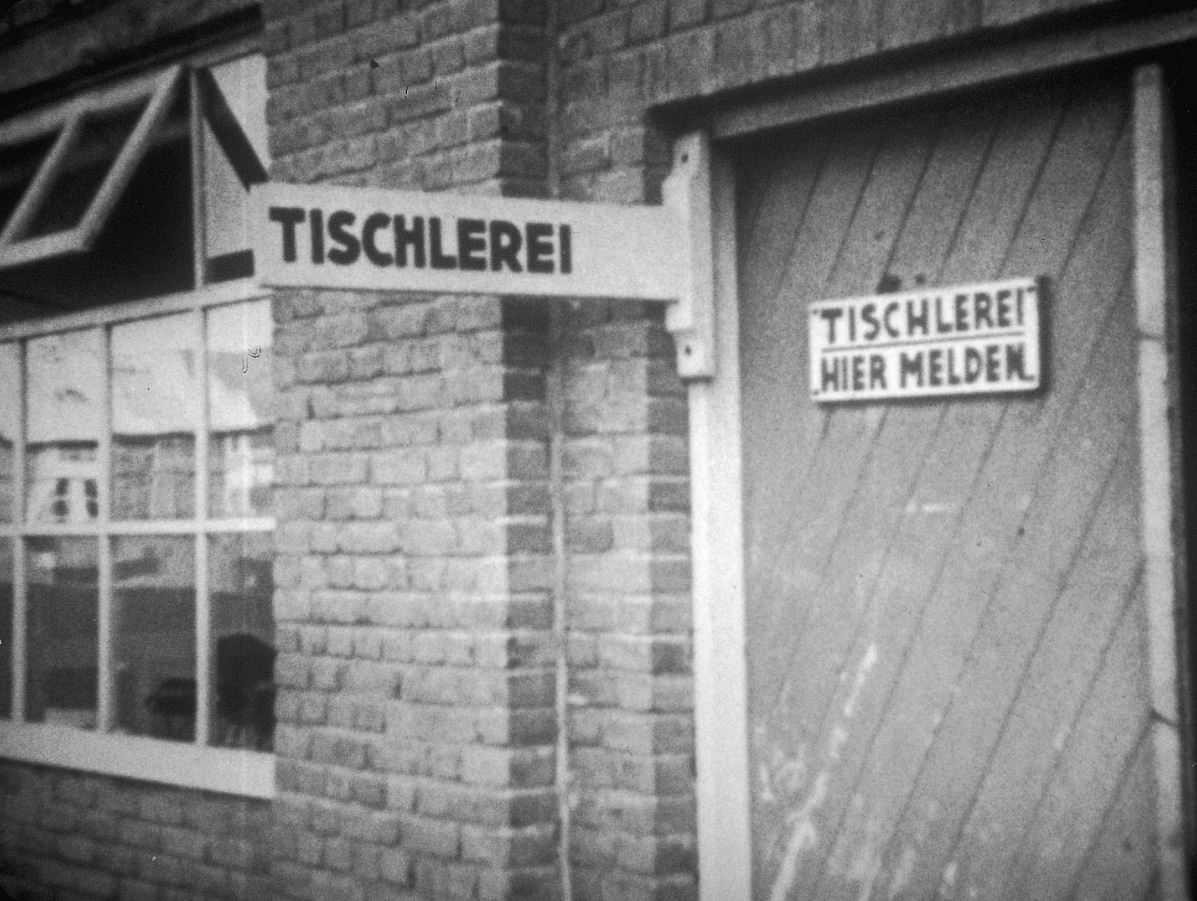
David Quiros spent several years of his life in the Westerbork concentration camp before he was finally liberated. He arrived in Westerbork at 30.12.1942 and managed to stay approximately two and a half years until his liberation on 08.06.1945.
Left: Carpentry workshop in the camp (collection HcKW - https://collecties.kampwesterbork.nl/werk/https%3A%2F%2Fdata.kampwesterbork.nl%2Fwork%2FHCIS.00021971)
David Quiros
- Voornaam
- David
- Achternaam
- Quiros
- Geboortedatum
- 08 oktober 1895
- Geboorteplaats
- Amsterdam
David Quiros was born on 8 October 1895. His birthplace was Amsterdam, where he lived his childhood with his mother Betje Swaluw, his father Isaac Lopes Quiros, and his 8 siblings: Mozes, Rachel, Mietje, Sara, Sophia, Jacob, Abraham and Hijman. His father Isaac was a businessman and merchant. In his youth, David learned the profession of a butcher.
Life became harder for him when the Nazis occupied the Netherlands in the war in May 1940. Step by step, discriminatory laws against Jewish individuals were enacted. In the area around Amsterdam, many labor camps – rijkswerkkampen - had already been established during the great depression in the 1930s, partly as work facilities for unemployed people. The Nazis later repurposed these camps as forced labor camps for Jewish people. Furthermore, Jews who became unemployed due to the Nazis’ anti-Jewish measures were also forced to work in these camps, while partly still sleeping at home. During the occupation, at least 13 Jewish labor camps were established in and around Amsterdam, serving as a prelude to deportation to Westerbork.
David Quiros worked in one of these forced labor camps before he was deported to the Westerbork concentration camp. While he was forced to work there, he was still able to live in the Vrolikstraat 363 in Amsterdam. He was eventually deported to Westerbork on the 18 July 1942. After his arrival, he received a camp pass for Westerbork, as regular passports had been confiscated from the prisoners. During his time in the camp, he was assigned to Barrack 18 and Barrack 58. Among other tasks, he sawed wood that had been transported to the camp into smaller blocks.
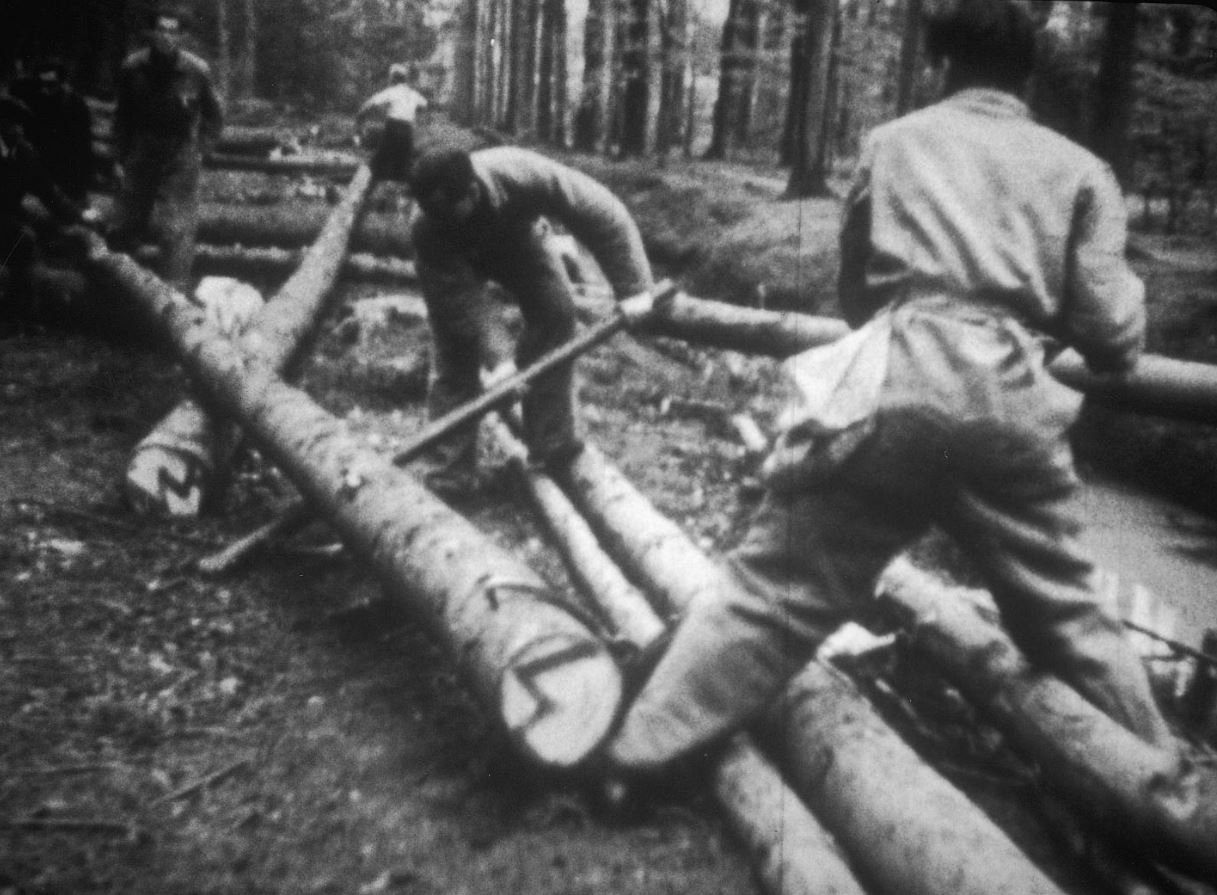 Prisoners of Westerbork working in the Asserbos (collection HcKW - https://collecties.kampwesterbork.nl/werk/https%3A%2F%2Fdata.kampwesterbork.nl%2Fwork%2FHCIS.00021801)
Typically, this wood came from felled trees, which were cut into smaller pieces and loaded into wheelbarrows to be brought into the camp – for example, to be used as fuel.
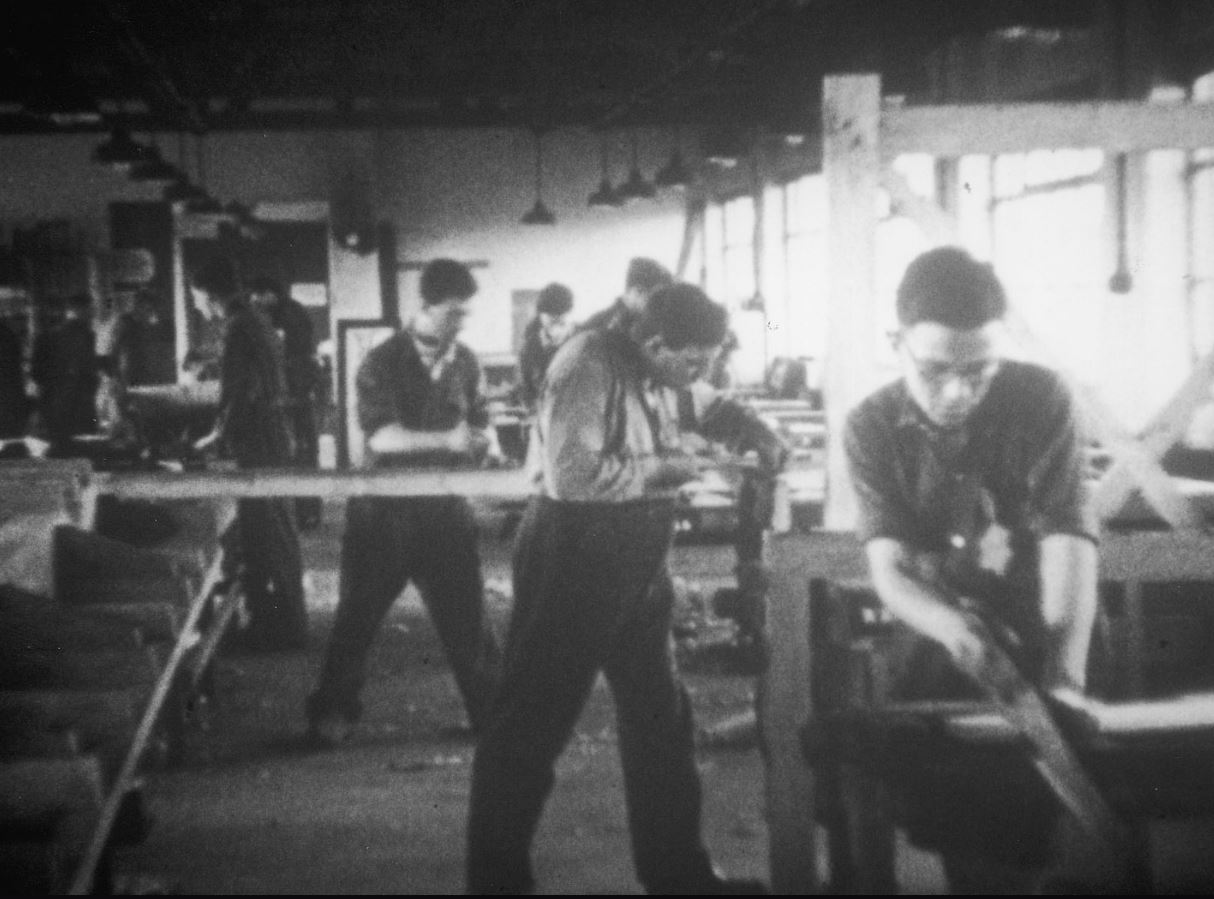
Prisoners working in the carpentry workshop (collection HcKW - https://collecties.kampwesterbork.nl/werk/https%3A%2F%2Fdata.kampwesterbork.nl%2Fwork%2FHCIS.00021973
The former liberated prisoner Riek Levie mentions David Quiros and the work on the saw in Westerbork in 1945 in the book “Mijn Levenspad”:
“Vaak stond ik aan de zaag tegenover ome Dovid, ofwel David Quiros, die na de bevrijding in Amsterdam een broodjes-met-vlees-zaak leidde. Arbeiders, jong en oud, mannen en vrouwen, droegen de omgevallen bomen naar de plek waar ze in stookbare stukken warden gezaagd of gehakt. De stukken warden op karretjes geladen en over een klein spoortje naar het kamp gereden.” (Riek Levie, Mijn Levenspad, 35)
“I often stood at the saw opposite Uncle Dovid, also known as David Quiros, who ran a meat sandwich shop in Amsterdam after the liberation. Workers — young and old, men and women — carried fallen trees to the place where they were sawn or chopped into burnable pieces. The pieces were loaded onto carts and transported along a small track into the camp.” (From: Riek Levie, Mijn Levenspad, p35)
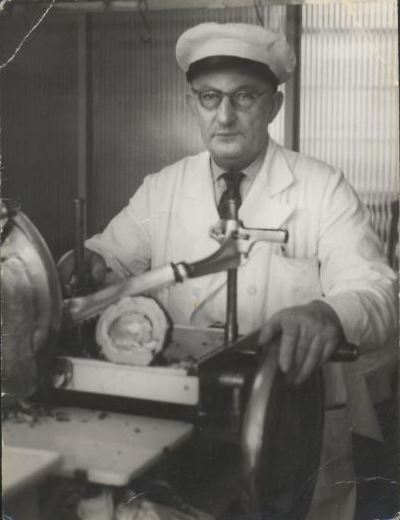 David Quiros after the war in his shop
(collection JCK - https://data.jck.nl/page/aggregation/jhm-foto/F010768)
On 8 Juny 1945, he finally left the camp and returned to Amsterdam.
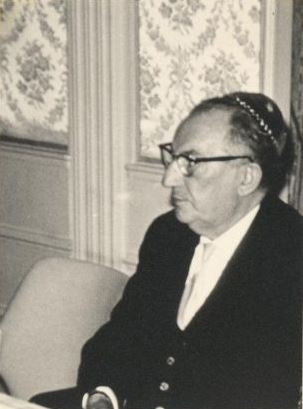 David Quiros after the war
collection JCK: https://data.jck.nl/page/aggregation/jhm-foto/F010769
When the Nazis abandoned the camp one day before the liberation by the Canadian army, it fell into self-administration by the prisoners. Many had to remain in the camp to allow the Canadian army to investigate why the remaining prisoners had not yet been deported. During this period of self-administration, David was part of a team of mediators who resolved disputes. On 8 Juny 1945, he finally left the camp and returned to Amsterdam, where he opened a sandwich shop, selling meat sandwiches.
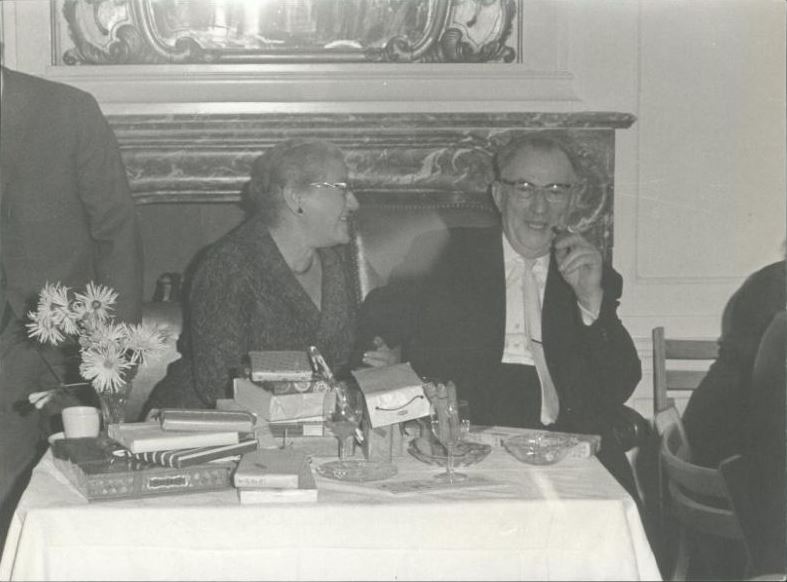 David Quiros in 1965, 70 years old - collection JCK: https://data.jck.nl/page/aggregation/jhm-foto/F010770
Moreover, he married Sara Bertha Philipson in February 1946 and remained married to her until her death in 1962. In November of the same year, he married Judith Glasbeek and moved to Haarlem, where he lived until his death on 21 August 1973.
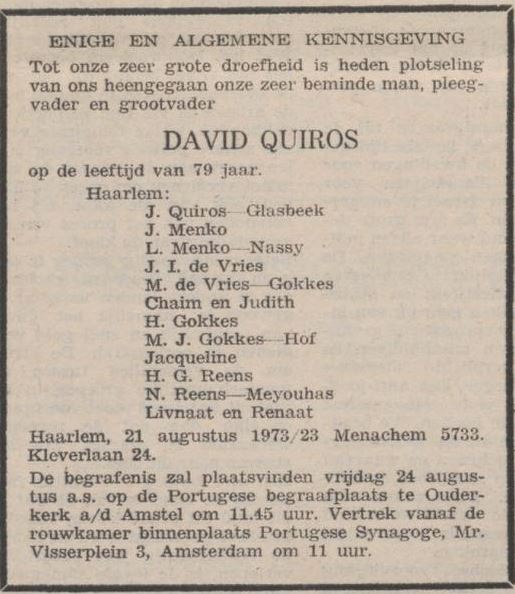 Familiebericht. "Nieuw Israelietisch weekblad". Amsterdam, 24-08-1973, p. 12.
Geraadpleegd op Delpher op 07-11-2025, https://resolver.kb.nl/resolve?urn=ddd:010872823:mpeg21:p012
Out of his immediate family, David was the only one who survived the war. All of his siblings, as well as one nephew were murdered by the Nazis - either in Auschwitz or Sobibor.
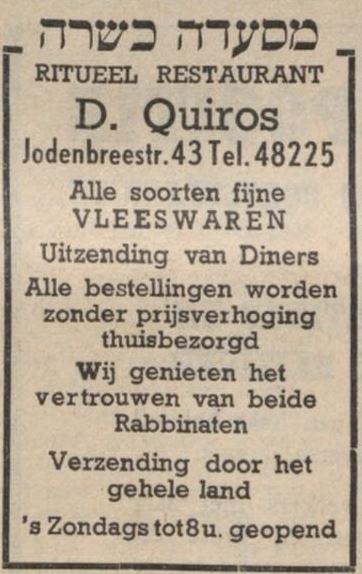 Advertentie. "Nieuw Israelietisch weekblad". Amsterdam, 10-02-1950, p. 5.
Geraadpleegd op Delpher op 07-11-2025, https://resolver.kb.nl/resolve?urn=ddd:010873945:mpeg21:p005
This portrait was written by Johannes Brandt, who works as a volunteer for ASF at Herinneringscentrum Kamp Westerbork.
